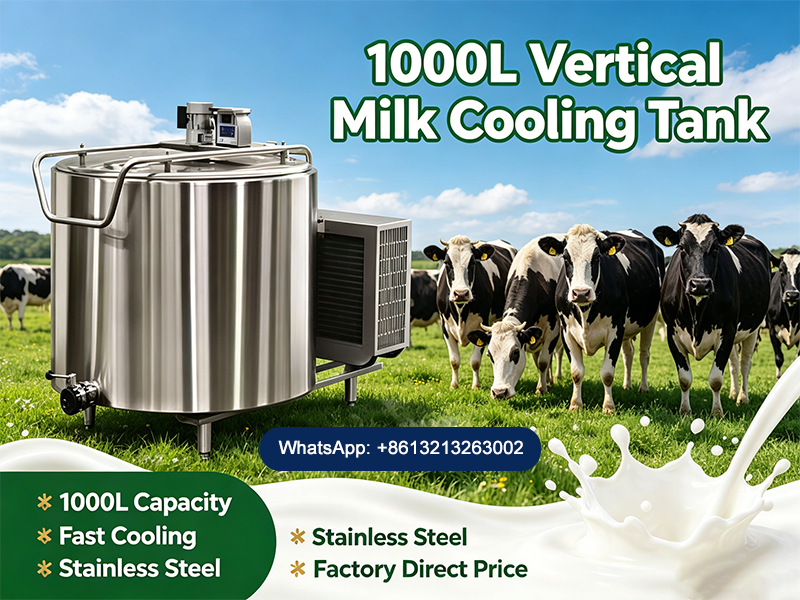
For food and dairy processing operations, cooling tanks are an essential piece of equipment; they are indispensable for the temporary storage of fresh milk, the cooling of beverages, and the preservation of raw ingredients. Currently, food-grade cooling tanks available on the market are typically constructed from one of two materials: 304 stainless steel or 316 stainless steel.
Many users find themselves in a dilemma: both are classified as food-grade stainless steel, yet their prices differ significantly. What exactly accounts for this difference? For those involved in the production of milk, yogurt, or general food processing, which material is the most suitable, cost-effective, and durable choice?
316 stainless steel contains an additional element called "molybdenum," whereas 304 stainless steel does not.
304 Stainless Steel: This is the standard food-grade material. It is perfectly adequate for daily use, offers sufficient rust resistance, and serves as the industry's basic-tier option.
316 Stainless Steel: This represents an upgraded, enhanced version. Thanks to the addition of molybdenum, it exhibits superior resistance to acids, salts, and corrosion caused by sanitizing agents, resulting in more stable and reliable performance.
Users need not be concerned about—or distracted by—the visual appearance; to the naked eye, both types of tanks look identical. There are absolutely no differences in their tactile feel, aesthetic appeal, or hardness; the *only* true distinction lies in their corrosion resistance and overall service life.
Normal wear and tear on a cooling tank is generally negligible; the true culprit behind tank failure is corrosion. Milk, fermented foods, and pickled products all contain varying levels of acidity and salinity; when these substances remain in prolonged contact with the tank walls, inferior materials can easily degrade, rust, or develop leaks.
These tanks are perfectly suitable for the daily storage of plain water or fresh, pure milk. However, their limitations are quite evident: they cannot withstand exposure to strong acids, high-salinity substances, or frequent, rigorous sanitization cycles. If used over the long term to store yogurt, fermented beverages, or pickling brines—or if subjected to daily cleaning with potent sanitizing agents—the tank walls will, within just a few years, begin to show small spots, yellowing, and surface layer degradation, ultimately leading to corrosion and leakage.
These belong to the "heavy-duty" or "rugged" category. While they are certainly capable of storing standard materials, they are specifically designed to handle highly corrosive substances—such as yogurt, fermented dairy products, savory sauces, and high-salt foods—without suffering any adverse effects, even during prolonged storage. Even with daily high-frequency disinfection and high-temperature sterilization, the tank body remains highly resistant to corrosion and aging; its long-term stability is significantly superior to that of 304 stainless steel.
Both 304 and 316 are legitimate food-grade materials that comply with food safety standards and do not leach harmful substances.
The distinction between the two lies not in their safety—as both are safe—but rather in their long-term stability and their susceptibility to harboring contaminants.
Pure milk has very low corrosivity; therefore, a 304 tank is entirely sufficient—it will not rust or contaminate the milk. The vast majority of milk collection stations and small-scale dairy plants utilize 304 cooling tanks, and they function without any issues.
After fermentation, these types of products exhibit high acidity; some also contain salts and sugars, which can cause gradual corrosion of the tank body over time. If a 304 tank is used, microscopic crevices—invisible to the naked eye—may gradually form on the tank walls. Milk residues and food particles can become trapped within these crevices; standard cleaning methods are often insufficient to remove them, leading to bacterial proliferation over time, which in turn causes product spoilage and reduces shelf life.
The surface of a 316 tank is denser and less prone to forming crevices; it does not trap dirt or harbor contaminants, allowing for more thorough cleaning. This makes it a more reliable choice for processing deep-processed dairy products and high-salt foods.
Assuming identical dimensions, configurations, and manufacturing processes, the price difference is straightforward:
304 Cooling Tank: Lower price point, high cost-effectiveness, and minimal initial investment; suitable for manufacturers with limited budgets.
316 Cooling Tank: Priced 15% to 30% higher than the 304 model due to higher raw material and processing costs. While the upfront expenditure is higher, it offers greater peace of mind and fewer complications in the long run.
Simple Summary: The 304 model saves money on initial procurement costs, whereas the 316 model saves money on future maintenance, equipment replacement, and costs associated with product quality issues.
The cleaning procedures for both tank models are identical: both can be washed with water and subjected to high-temperature sterilization, with no operational differences.
The Distinction: 304 tanks should not be subjected to frequent, aggressive cleaning using high-concentration disinfectant solutions, as this can accelerate corrosion. 316 tanks, however, can be cleaned without such restrictions; simply follow the facility's standard disinfection protocols without the need for overly cautious or delicate handling.
304 Cooling Tanks: Suitable for storing fresh milk or clean water, offering a service life of 8–12 years. However, when used for fermented products or high-salt materials, issues may arise within just 3–5 years.
316 Cooling Tanks: Versatile enough for all applications; under normal usage conditions, they last 12–15 years. Even in highly corrosive deep-processing environments, they can reliably serve for over 10 years.
In typical inland food processing plants or dairy collection stations—where the environment is dry and free of salt mist—there is little practical difference between using 304 and 316 stainless steel; both perform reliably.
In coastal areas, the air has a high salt content. In workshops that remain humid for extended periods or undergo frequent water-based cleaning, 304 tanks are highly susceptible to oxidation, rusting, and corrosion caused by salt mist. The 316 material, with its superior resistance to salt mist and humidity, demonstrates a distinct advantage in such environments.
In workshops that undergo frequent high-temperature disinfection and repeated sterilization cycles, 316 stainless steel offers greater stability; it is less prone to deformation or corrosion, resulting in significantly higher durability.
|
Comparison Item |
304 Stainless Steel Cooling Tank |
316 Stainless Steel Cooling Tank |
|
Material Composition |
Chromium-nickel alloy, no molybdenum element |
Chromium-nickel alloy + molybdenum (upgraded corrosion resistance) |
|
Food Safety |
Regular food grade, safe and compliant |
Regular food grade, better stability |
|
Acid and Salt Resistance |
Average, only suitable for neutral and weakly acidic materials |
Excellent, suitable for high-acid, high-salt, and fermented materials |
|
Scale and Corrosion Resistance |
Sufficient for ordinary scenarios, prone to dirt accumulation in corrosive environments |
Resistant to corrosion, no scale accumulation, easier to clean |
|
Equipment Price |
High cost performance, low investment |
Relatively high price, higher investment |
|
Service Life |
8-12 years in conventional scenarios |
12-15 years in conventional scenarios, great advantage in corrosive scenarios |
|
Applicable Scenarios |
Dry workshops, fresh milk, ordinary food processing |
Humid/coastal workshops, deep processing, high-corrosion production |
If your situation matches the following criteria, choosing Grade 304 stainless steel is a perfectly sensible and cost-effective choice:
You process only fresh raw milk, pure milk, standard fruit and vegetable juices, or plain water—materials that are neither acidic nor salty;
Your workshop environment is dry and not located in a coastal region;
You have a limited budget and wish to keep equipment costs under control;
Routine cleaning does not involve the use of harsh disinfectants, and maintenance protocols are followed diligently;
You operate a small-to-medium-sized milk collection station or a small food processing plant with simple production processes.
In short, if you are processing only standard fresh milk or basic food products, choose Grade 304—it saves money and is perfectly adequate for the job.
If your situation matches the following criteria, you should opt for a Grade 316 cooling tank:
You produce acidic dairy products such as yogurt, fermented milk, cheese, or flavored milk;
You process pickled, seasoned, or high-salt food products;
Your facility is located in a coastal area, or your workshop is consistently damp and prone to heavy condensation;
Your workshop requires frequent, high-intensity daily disinfection using strong chemical disinfectants;
You operate a medium-to-large-scale facility with rigorous standards for product quality and hygiene;
You wish to avoid frequent equipment repairs or tank replacements, seeking a long-term, hassle-free solution.
In summary, if you are processing fermented, highly acidic, or high-salt products—and your priority is long-term production stability—choose Grade 316 without hesitation.
You may not notice any major issues within the short term (e.g., 1–2 years); however, over a longer period, the material will inevitably corrode, accumulate milk residue, and harbor bacteria, thereby compromising product quality. Therefore, we do not recommend using it for long-term storage.
Yes, it can. Grade 316 outperforms Grade 304 in every respect and is suitable for every application where Grade 304 is used. The only caveat is that using Grade 316 for standard applications constitutes "overkill"—providing performance beyond what is strictly necessary—and therefore offers lower cost-effectiveness compared to Grade 304.
They look, shine and feel exactly the same. It can only be determined through professional testing. When purchasing, be sure to check the material report provided by the manufacturer to avoid being deceived by inferior products.
The basic cleaning process is the same. The difference lies in that 304 is sensitive to vigorous cleaning and strong disinfectants, while 316 can be cleaned casually and is more durable.
It is highly not recommended. Replacing the equipment requires downtime, incurs additional purchase costs, and also affects production and quality. For processing-intensive scenarios, 316 should be used directly. For ordinary scenarios, 304 is completely sufficient.
Neither cooling tank model is inherently "better" or "worse"; it simply comes down to which is the right fit for your needs. Choosing based on your specific requirements is the most cost-effective and hassle-free approach:
304 Stainless Steel Cooling Tank = High-Value, Essential Model. Ideal for fresh milk storage, general food processing, dry processing environments, and small-to-medium-sized manufacturers. It is budget-friendly and perfectly adequate for everyday use.
316 Stainless Steel Cooling Tank = High-Quality, Durable Model. Ideal for fermented dairy products and the intensive processing of high-acidity or high-salt foods. It is well-suited for coastal, humid, or high-frequency sterilization environments, offering superior hygiene and stability for a longer service life.
Selecting the right material not only saves money on replacements and equipment upgrades but also safeguards product quality right from the source—making it the most practical and effective strategy for food and dairy factories to reduce costs and boost efficiency.
contact : Anny Zhang , Macros Zhang
Phone number : 008613213263002 008613213263322
Fax : 0086-372-2190333
E-mail : info@bidragon.com sales2013@bidragon.com
Skype : hwbzzm bidragon2013
Address : No.2-1803 Soubao Business Center, No.16 South-West Third Ring Road, Beijing,China.
 United states (English)