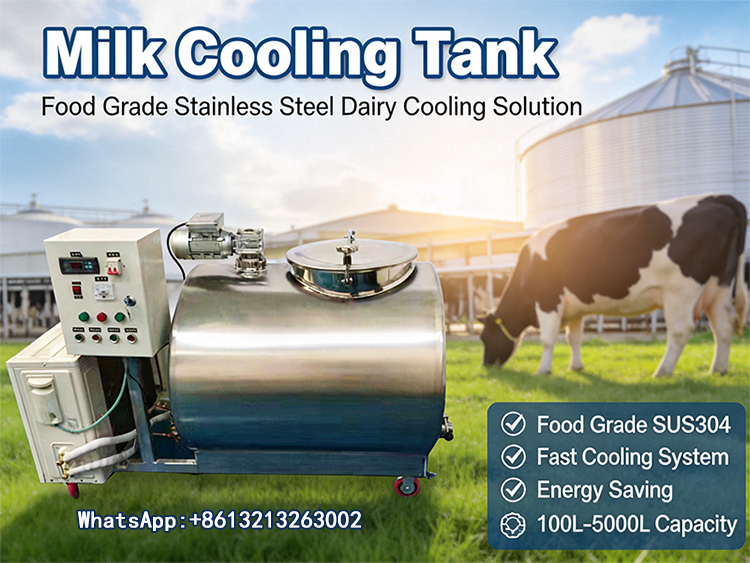
As a manufacturer in the refrigeration tank industry, we have witnessed many cases where a good batch of milk fetched a higher price due to a single tank of cooling, and also seen the regret of entire batches of milk being rejected due to insufficient cooling. Today, let's talk about why 304 stainless steel cooling tanks have become the standard equipment in dairy farms.
Whether you have a family farm with 10 to 15 cattle or a large-scale ranch with over 10,000 cattle, the 304 stainless steel cooling tanks can precisely meet your usage needs. The capacity ranges from 100 liters to 100 tons, allowing for on-demand selection without wasting equipment costs or leaving equipment resources idle. They are suitable for all types of livestock farming scenarios.
The small-capacity models occupy minimal space, have a simple installation process, and have low installation costs. They perfectly fit the daily demand of small family ranches for producing several hundred liters of fresh milk, being sufficient, convenient, and cost-effective.
The cooling performance is stable, the cooling efficiency is high, and the automation level is excellent. They can easily handle the daily milk production of several tons for ranches, perfectly matching the regular milking operation rhythm of medium-sized ranches.
Equipped with a multi-head parallel cooling system, it supports remote monitoring operations. The performance is powerful and the operation is stable. It can store and process over ten tons of fresh milk at once, perfectly adapting to the large-scale and large-volume milking production needs of large ranches.
At present, the annual output of dairy products across the country reaches as high as 46 million tons. Stable and reliable refrigeration tank equipment is the core guarantee for the huge production capacity of the entire dairy industry.
During the peak period of milking at the dairy farms, thousands of liters of fresh milk are continuously produced in a short time. Ordinary cooling equipment has slow cooling speed, short battery life and is prone to shutdown, which simply cannot keep up with the milking rhythm. However, the 304 stainless steel cooling tank is equipped with international brand compressors. Its core advantage is high cooling efficiency and support for long-term continuous and uninterrupted operation. It can operate stably without stopping throughout the day.
Among them, the high-end models perform even better. They can quickly reduce 35℃ warm fresh milk to 4℃ in just 2.5 hours, with a cooling speed far exceeding the international industry standards. No matter how many times the dairy farm milks per day or how high the daily milk production, the equipment can always receive milk and maintain stable cooling, completely solving the industry problem of having no place to store fresh milk and causing it to accumulate and deteriorate.
The fresh milk just extracted from the cows has a temperature ranging from 35 to 36 degrees Celsius, which is similar to human body temperature. This temperature is the ideal temperature for bacterial reproduction. Every minute delay will cause the quality of the fresh milk to deteriorate by one level, and the risk of spoilage will significantly increase.
According to industry statistics, the industry compliance rate for cooling the fresh milk to below 4 degrees Celsius within 2 hours after production is only 82%. This is the core gap that leads to inconsistent quality of fresh milk and inability to sell at high prices in many dairy farms. The 304 stainless steel cooling tank has a temperature control accuracy of ±0.3 degrees Celsius, which is three times more precise than ordinary equipment. It can effectively prevent the protein in the fresh milk from denaturing and the bacteria from multiplying excessively, locking the milk quality at the source.
At the same time, the tank body is equipped with a thick polyurethane integral foam insulation layer, with a thickness of up to 80mm, providing extremely strong insulation performance. The temperature rise inside the tank within 24 hours does not exceed 2 degrees Celsius. Even in the event of a power outage at the dairy farm lasting for half a day or equipment failure, the temperature inside the tank will not increase significantly, ensuring the quality of the fresh milk and avoiding the loss of the entire batch of fresh milk caused by unexpected situations.
Fresh milk is produced on the farm and transported to the dairy processing plant. The entire process is a race against bacteria. Every additional hour of delay increases the risk of milk spoilage.
The national industry standard clearly stipulates that for fresh milk transported within 30 hours, the overall temperature increase must not exceed 2℃. If the initial cooling at the farm is not thorough enough, or the storage temperature is unstable, the factory's delivered milk temperature will not meet the standards, and it will almost always fail the inspection upon arrival at the processing plant, facing rejection losses.
The 304 stainless steel cooling tank builds the first line of defense for the quality of fresh milk. After the milk is produced, it can quickly and stably cool down to 4℃ and be continuously stored at a constant temperature. When the milk truck makes door-to-door transfer and transportation, the milk temperature remains stable and meets the standards, significantly reducing the preservation pressure during subsequent transportation and effectively avoiding problems such as temperature exceeding the limit and deterioration of milk quality during transportation.
The first inspection process for milk collection by major dairy plants is temperature measurement. Milk that fails the temperature test will be directly rejected. A high-quality 304 stainless steel cooling tank is the first insurance for the quality of fresh milk at the farm, firmly maintaining the qualified standards for fresh milk.
The rapid cooling function is the core and most crucial performance of the cooling tank, and it is also the key factor that determines the quality difference of fresh milk.
The bacteria in fresh milk grow exponentially at a rate of doubling every 20 minutes in a 30℃ environment. This means that the faster the cooling speed, the lower the total bacterial count in the fresh milk, the fresher the taste, and the higher the acquisition grade and acquisition price.
The high-quality 304 stainless steel cooling tank has the ability to lock the freshness of the fresh milk. It takes only 20 seconds for the fresh milk to cool from 36℃ to 10℃. The entire process is rapid cooling, and it only takes about 2 hours to drop the temperature to the standard preservation temperature of 4℃, instantly locking in the original nutrients and fresh flavor of the fresh milk.
At the same time, the equipment adopts a uniform cooling mode throughout the entire area, and there will be no problem of uneven cooling where the tank wall temperature is low while the center temperature is high. Combined with a timed stirring system, it operates automatically throughout the process, which can not only ensure the uniform temperature of the entire tank of fresh milk but also prevent the fat in the milk from settling and stratifying, ensuring that each batch of fresh milk has uniform quality, significantly improving the acquisition quality.
Fresh milk is a food that is directly consumed. The material of the storage equipment directly determines the safety of the milk source. This is the core reason why the dairy farm must choose 304 stainless steel cooling tanks.
304 stainless steel is a food-grade special material in accordance with national standards. Its chromium and nickel content reaches the 18/8 standard, possessing extremely strong corrosion resistance. It does not rust or have any odor when storing milk for a long time, and does not undergo any chemical reactions with the milk, completely eliminating any secondary contamination of the milk source. The inner wall of the tank is processed by electrolytic polishing, which is smooth and fine, does not stick to milk, has no residue, and bacteria have no place to hide. This ensures the hygiene and safety of fresh milk from the material level.
The equipment is equipped with a CIP automatic cleaning system, which is equipped with 360° rotating spray balls. It can achieve thorough cleaning of the tank without any dead corners, eliminating the need for manual climbing and cleaning of the tank. This not only saves labor costs but also avoids hygiene hazards caused by incomplete cleaning by manual methods. After cleaning, it can automatically drain and air-dry, ensuring that the tank is clean and sterile for the next use, and providing full protection for the safety of milk storage.
This equipment has extremely strong durability. With normal maintenance and use, it can last for ten to eight years. Calculated in terms of daily usage costs, it is extremely low. However, it can completely prevent bad milk, loss from rejection, stabilize the production of high-quality fresh milk, and earn a high-quality milk price difference over the long term. Its comprehensive cost performance is extremely high.
In the end, the core purpose of dairy farming is to sell stable and high-priced fresh milk. Although the 304 stainless steel cooling tanks are an investment in equipment, they are definitely the most cost-effective and necessary investment for the dairy farm.
It directly determines whether the fresh milk from the farm can meet the A-level purchase standards, whether it can be sold at a high market price, and whether it can avoid losses caused by the rejection of entire batches. If the equipment maintains stable temperature control, the quality of the fresh milk will be stable; if the quality of the fresh milk is stable, the breeding income of the dairy farm will also be stable. This is the fundamental reason why 304 stainless steel cooling tanks can be widely popularized and become the standard equipment for dairy farms of all sizes across the country nowadays.
contact : Anny Zhang , Macros Zhang
Phone number : 008613213263002 008613213263322
Fax : 0086-372-2190333
E-mail : info@bidragon.com sales2013@bidragon.com
Skype : hwbzzm bidragon2013
Address : No.2-1803 Soubao Business Center, No.16 South-West Third Ring Road, Beijing,China.
 United states (English)